



Know When Customer Value Is Building & When It Starts to Slip
Traditional product analytics show what customers do. The Activation Ladder turns product activity and inactivity into actionable insights, showing Customer Success teams where to intervene to prevent churn and protect NRR.
Trusted by 1,200+ B2B Technology Teams









Activity Is Not the Same as Product Adoption & Value
A customer might log in daily, yet never use the product in a way that generates a true return on investment. Conversely, another customer may log in far less frequently, but engage deeply with key value-drivers to achieve meaningful results.
The most important signal is not whether the customer is active. It is whether the customer is achieving and sustaining the outcomes they paid for.
Traditional telemetry measures
- Who logged in?
- What features were used?
- How often something was clicked?
- Did usage increase or decrease?
The Activation Ladder measures
- Did the customer reach a core value milestone?
- Are they consistently achieving expected outcomes?
- Have they progressed to a higher-value usage tier?
- Are key accounts falling below value thresholds?
- Which specific accounts are regressing right now?
The Difference Is Motion
While a health score provides a static snapshot of where a customer stands, an Activation Ladder delivers the full story. It reveals how they got there, whether their value state is sustainable, and whether they’re progressing or beginning to slip backward.
Accelerating
Achieving new outcomes and progressing toward higher-value states.
Sustaining
Continuing to demonstrate the behaviors and outcomes that justify their current value state.
Stalling
Not progressing toward the next meaningful outcome.
Regressing
Losing a previously achieved value state and failing to meet the conditions required to sustain it.
What Is an Activation Ladder?
An Activation Ladder is a customer-defined, five-stage value framework that guides users from initial setup to long-term adoption. Each stage reflects a key business outcome customers unlock as they mature with your product.
The measurable outcomes that prove a customer has reached a new value state.
The measurable outcomes that prove the customer is continuing to realize that value over time.
Move forward
When they achieve the activation criteria for the next stage.
Hold position
When they continue to meet the sustaining criteria for their current stage.
Move backward
When the sustaining behaviors that once proved value begin to disappear.
That backward motion is often the most important signal of all.
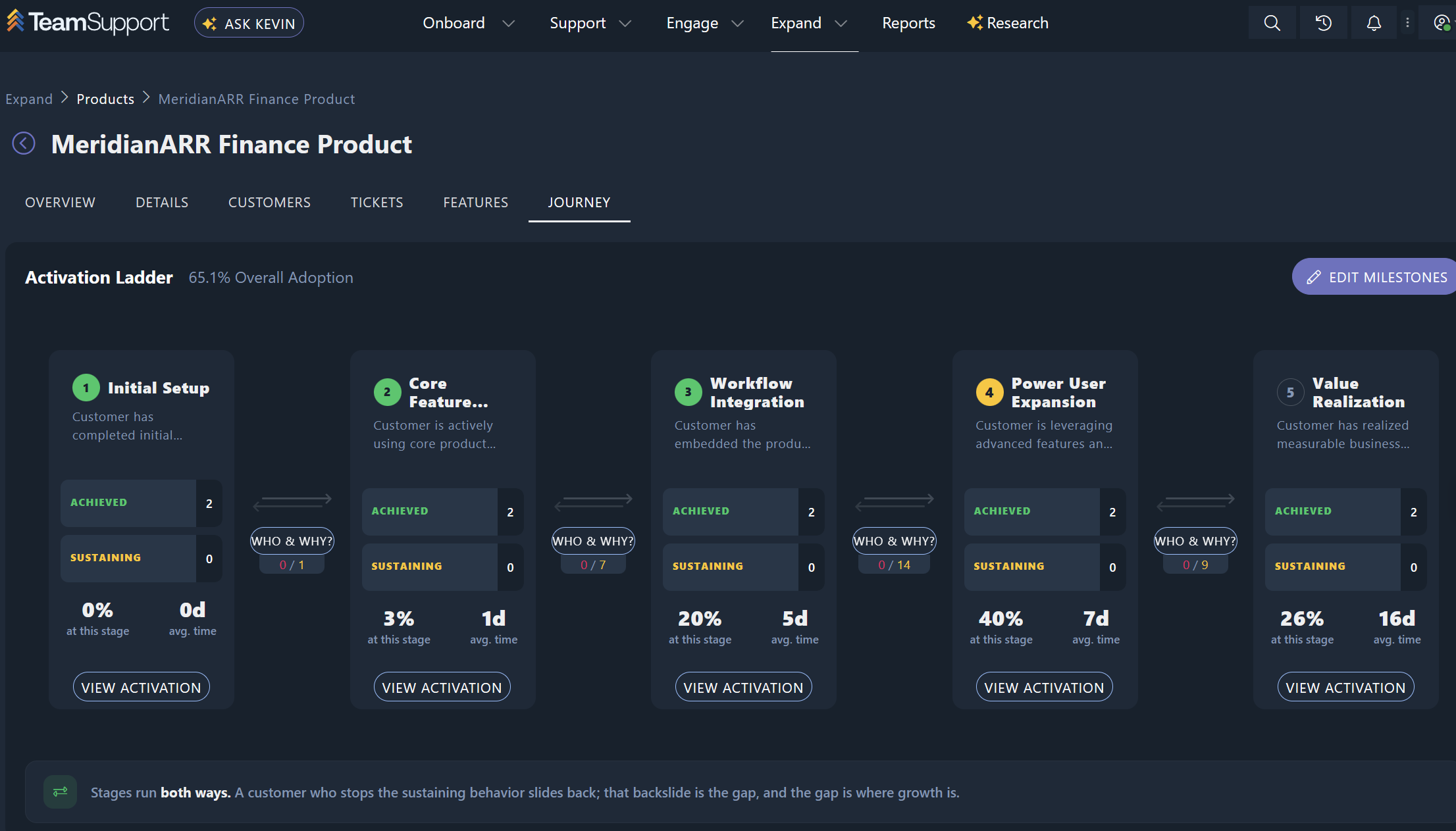 Defined value stages Achieved vs. sustaining
 How Activation Ladder Catches Value Erosion Early
Traditional churn indicators arrive far too late. A drop in logins, a tense renewal call or negative feedback only surface long after a customer’s momentum slows down.
By measuring movement across value stages rather than surface-level activity, an Activation Ladder flags backward motion the moment outcomes stop being achieved, often months before churn happens.
Backward motion
- Onboarding completion begins to fall
- A critical workflow no longer meets the sustaining threshold
- Usage is present, but the business outcome is no longer achieved
- Expansion-ready account stops showing supporting behaviors
The customer stopped achieving the outcomes that previously demonstrated value.
Example: What a Five-Stage Activation Ladder Looks Like
Every company defines value differently. The stages below are one example of how a B2B SaaS company might configure their ladder. You define the stages, outcomes, and thresholds that match your customer journey.
1 Connected
Can we establish a trusted view of the customer?
Connected
Can we establish a trusted view of the customer?
The customer has built the data foundation required to understand who their customers are, what they are worth, what they use, when they renew, and where they experience friction.
At least 80% of active customers have complete account, commercial, and product data while live customer activity is flowing into those records.
For four consecutive weeks, at least 70% of active customer accounts continue accumulating meaningful account-level context while overall data completeness remains above the defined threshold.
A usable customer intelligence foundation exists - and remains alive.
2 Repeatable
Can we consistently get customers to value?
Repeatable
Can we consistently get customers to value?
The customer has operationalized the workflows that create a successful customer experience, such as onboarding or autonomous support.
New customers are consistently enrolled in a structured onboarding process, or eligible support work is successfully resolved through autonomous support while meeting defined quality thresholds.
The motion continues to perform across multiple cohorts or periods without a decline in outcome quality.
Time to value becomes measurable instead of anecdotal.
3 Proactive
Can we detect when customers are failing to adopt and change the outcome?
Proactive
Can we detect when customers are failing to adopt and change the outcome?
Product behavior, support friction, onboarding history, and account context are used together to identify customers whose adoption is below expectations.
Across a defined cohort of under-adopting customer accounts, the majority receive an intervention and a meaningful percentage subsequently demonstrate improved product behavior.
The same intervention motion continues to improve adoption across multiple cohorts.
Customer teams stop waiting for customers to tell them there is a problem.
4 Growing
Can we turn customer intelligence into expansion revenue?
Growing
Can we turn customer intelligence into expansion revenue?
The same signals that expose risk can also reveal opportunity: strong adoption, growing usage, unmet needs, product affinity, feature requests, and expansion readiness.
A customer growth opportunity identified through TeamSupport intelligence converts into measurable expansion ARR.
TeamSupport-surfaced opportunities consistently generate measurable pipeline and closed expansion revenue.
Customer intelligence is no longer only protecting revenue. It is creating it.
5 Compounding
Can we prove that the customer operating model is improving retention and net revenue?
Compounding
Can we prove that the customer operating model is improving retention and net revenue?
The full lifecycle comes together: Time to Value, Adoption, Support, Expansion, Renewal. Customers reach value faster, adopt more deeply, experience less friction, expand when appropriate, and renew at stronger rates.
A meaningful renewal cohort demonstrates improvement against an established retention baseline.
Improved GRR, NRR, renewal performance, or another agreed retention outcome remains durable across multiple renewal periods.
Customer value becomes visible in the economics of the business.
How It Works for Your Organization
Your organization defines customer value differently. The Activation Ladder isn't a universal health score or opaque AI-generated maturity label. It's a transparent roadmap built around your definition of customer success. By mapping outcome-based milestones, it reveals true adoption, catches value decay early, and guides every account toward long-term growth.
Explore Our Customer Success SolutionYour business defines:
- The stages across your customer journey
- The core outcomes that drive value at each stage
- The activation criteria that validate outcome achievement
- The baseline behaviors that ensure sustained value
- The signals that indicate forward progress or regression
TeamSupport consistently evaluates these conditions across every account, giving you a clear, measurable view of customer value progression.
One Construct. Many Surfaces.
Activation Ladder state and motion are not trapped in a dashboard. The resulting intelligence can be surfaced wherever teams and systems need it.
Customer Records
See the customer's current stage and direction.
Operational Views
Identify customers moving forward, stalling, or regressing.
Intelligence Experiences
Combine ladder state with support, product, commercial, and relationship context.
Automation and Workflows
Use state changes as triggers for customer actions.
API Access
Expose activation state and motion to external systems, data platforms, CRM workflows, or internal applications.
The goal is not another report. The goal is to make the customer value state actionable everywhere.
From Customer Activity to Customer Trajectory
Watch the on-demand demo to see how TeamSupport spots when customers stop realizing value before it costs you the renewal.
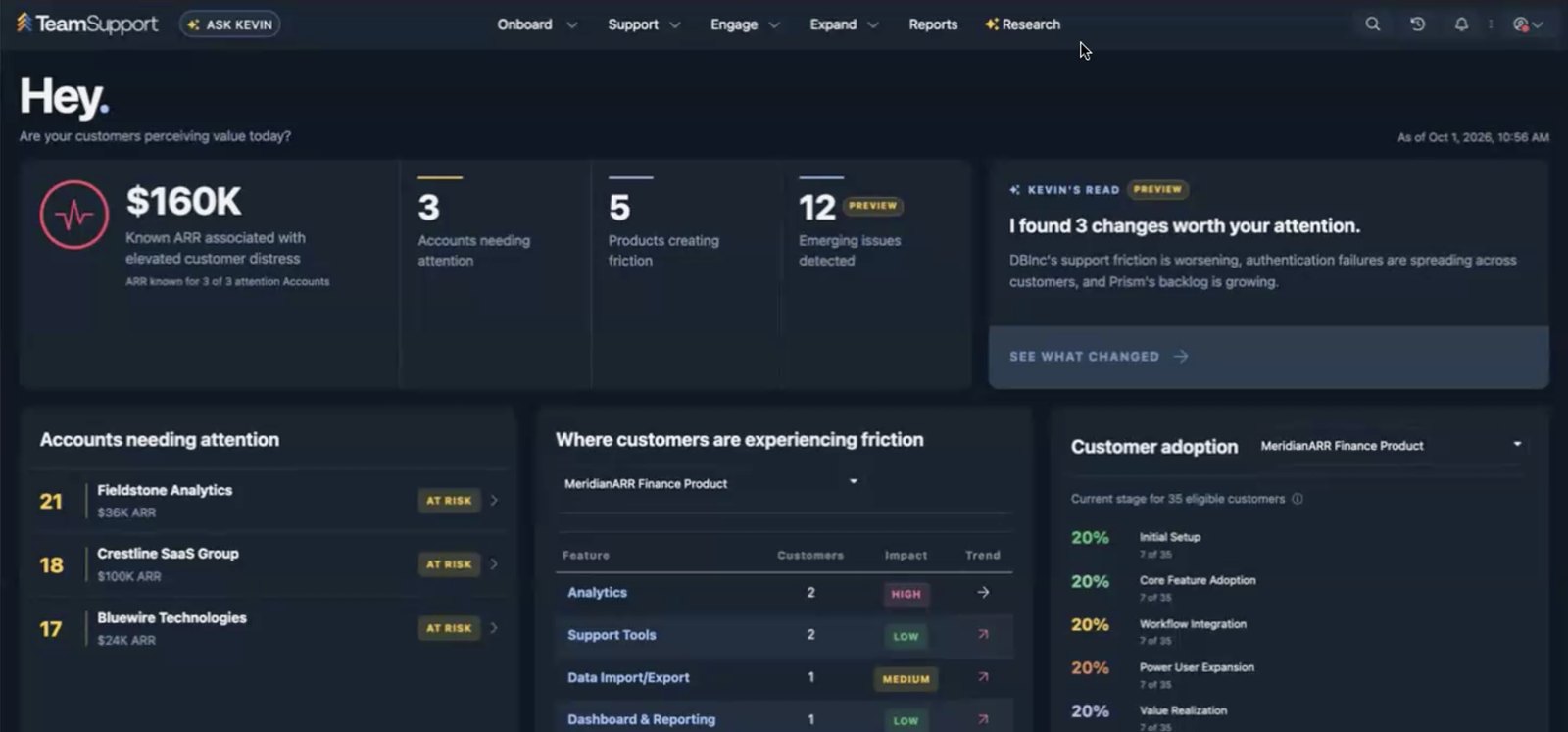
In This Demo
- 33:52Customer Success Intelligence
- 35:55Product Adoption & Activation Ladder
- 42:55Playbooks for Success: Churn prevention, renewals & expansion
See It in Action
Build Your Customer Journey
Around the Value You Promise
The Activation Ladder turns the value your product promises into an operational state that can be measured, monitored, and acted on.
Onboarding included. 4-6 week implementation.